Ethical and Philosophical Concerns of Using Human Neurons in Computing
Project Videos
Here you will see videos covering the variety of topics surrounding the ethical and philosophical concerns of using human neurons in computing. The videos are made in order, with references back to previous videos made, however enough context should be given in a video to properly understand a topic.
Jump To:
5: Integrated Information Theory
6: Higher-Order Theory/Theories
7: Moral Status: Does Consciousness have Ethical Value?
8: Climate Ethics: Potential Climate Impact of Widespread Organoid Use
9: Sourcing of Neuron Organoids
10: Communicating Organoids to the Public
11: Synthetic Biological Intelligence: What Would an SBI Imitating a Human Be?
Introduction
This video gives a general introduction to the various topics that will be discussed in this project in their respective videos. Along with the videos, there will also be transcripts and paragraphs describing topics mentioned in the video and other related points.
What Are Organoids?
Organoids are minituraized versions of any sort of organ, such as kidneys, intestines, and in the case of this project, the brain. Before we go into discussions of popular theories of consciousness, a good understanding of what neuron organoids, or brain organoids, are is necessary.

Neuron organoids or human brain organoids (HBOs), are lab-grown clusters of neurons that can be used to study the brain, test medicines, or perform computation. Recent developments in using brain organoids (which will be commonly referred to as just organoids in this project for brevity) in computing include neurons learning how to play Pong, being trained to control a butteryfly and, in Feburary 2026, Cortical Labs, a company specializing in using neurons in computing, taught neurons how to play the basics of doom.
This shows the rapid pace of development in organoid computing, which shows how important it is to answer ethical concerns surrounding them.
Futher Reading: Living Human Brain Cells Play DOOM on a CL1
The Consciousness Problem
Defining and explaining non-material ideas such as the mind, the soul and consciousness has been challenges for centuries and millenia in philosophy. It's only relatively recently that science has finally able to study consciousness and come up with various theories, even if those theories themselves have more of a philosophical grounding than a scientific one.
Since we can't come to an agreement on what causes consciousness, with the only factor often being the brain, this puts brain organoids in a unique ethical position. Is the creation and research of them morally sound if we can't prove whether or not they are conscious?
Now that we now what organoids are, lets discuss the issue of consciousness. The consciousness problem is the question of whether or not neuron organoids could be considered conscious, and if research and development of them is moral and ethical.

Argument Against Organoid Creation
The general argument against use of neuron organoids, formed from what seems to be general opinions seen about them online, can be expressed as the following series of premises:
1: Consciousness is a characteristic associated with brain, or at least brain matter/neurons.
2: Despite association with the brain, we can’t define how consciousness arises exactly.
3: A being we believe to possess consciousness, particularly human consciousness, is something that has intrinsic moral worth.
4: The consciousness that arises from an organoid would be like the consciousness of human beings.
5: The state of conscious existence for an organoid would not be moral to subject something we believe to be conscious to.
6: If we can’t prove or disprove an organoid possesses consciousness, the most moral decision would be to assume it could be conscious.
Conclusion: Since we cannot say for sure how consciousness arises, only that it is associated with the brain, and neuron organoids are made up of the same matter as our brains, we can’t say for sure whether an organoid could possess consciousness. Since we can’t say for sure whether they are conscious or not, the most moral action would be to assume they are, and we should not develop them at all, as subjecting a potentially conscious entity to be mere processing power would be immoral.
This is the general argument which will be partially tackled in some videos and discussions, with specific premises being countered.
Global Workspace Theory
GWT was developed by neuroscientist Bernard Baars in the 80's, and has seen widespread interest. A theater metaphor is often used to describe Global Workspace Theory, with a spotlight representing what we are aware or conscious of, that can change its attention to other unconscious things on the stage.
A more concrete example of GWT in relation to the brain would be seeing text on a screen, having it processed in the occipital lobe, then broadcast to other areas of the brain such as parts that deal with language, emotion, or memory. This broadcasting of the information throughout the brain makes us conscious of the text.
To understand what consciousness is and what could cause it, 3 theories of consciousness will be explored. The first is Global Workspace Theory or GWT, which believes consciousness comes from the broadcasting of information thoughout a system, such as the brain. Theories relating to the brain and neurons are often referred to as Global Neuronal Workspace Theories, or GNWTs.
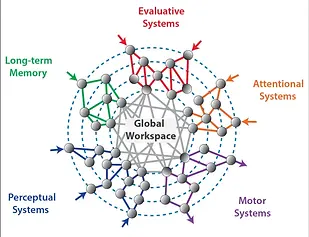
Global Workspace in the brain, according to GWT
Futher Reading:
Fame in the Brain—Global Workspace Theories of Consciousness
Integrated Information Theory
Perhaps the most unique out of all the theories of consciousness discussed here, Integrated Information Theory, or IIT, is a theory that believes consciousness arises when a system has elements that have physical cause-effect power on other elements. It proposes a mathematical way of measuring the quantity of consciousness within a system, and this amount is referred to as the Phi value (Φ).

IIT stands out from other theories of consciousness due to the lack of any explicit or implicit relation to biology. GWTs tend to be focused on how the brain creates consciousness, and Higher Order Theories are being shown to have potential roots in the Prefrontal Cortex. IIT removes all links and proposed simply something with enough physical cause-effect power, which although unique, has garnered a lot of criticism.
Criticisms that IIT is a form of Panpsychism, that everything could be conscious, if often given. If there is no biological basis of consciousness, then AI consciousness could be real, let alone organoid consciousness. Controversy around IIT came to a head in late 2023 when a group of scientists came out labelling IIT as a pseudoscience, which caused major uproar in the field on consciousness.
Futher Reading:
Letter stating IIT as Pseudoscience: https://osf.io/preprints/psyarxiv/zsr78_v1
IIT Expanded On: Integrated Information Theory of Consciousness
Higher-Order Theories
First order states can be regarded as a sort of general subjective experience, such as reading text on a screen or feeling temperature. Under Higher Order Theories, such as Higher Order Represenationalism, something has to be aware that they are experiencing that first order state to be considered conscious.
One way of thinking about it would be that a first order state, such as feeling warm, could be expressed as "hot", but a higher order representation monitoring this could express it as "I'm hot".
A theory with roots in philosophy that has remained relevant in the era of scientific research, Higher Order Theory (or theories if referring to all derived theories), states something is phenomenally conscious if it possesses some form of a "higher order representation" that is able to monitor "first order" states.


Higher Order Theories have implicit roots in philosophy, such as with Immanuel Kant's idea of "inner sense" he thought up with during the 1700's, which is where our instrospection and our awareness of ourselves comes from. Descartes' "I think, therefore I am", could be interpreted too as a sort of higher order awareness being aware of its first order state of existing.
Futher Reading:
HOT Encyclopedia Entry: https://iep.utm.edu/higher-order-theories-of-consciousness/
In the argument against organoid development and research, specifically point 3, its mentioned that anything that is conscious has moral worth. Is this a fair claim to make? Intuitively, yes, but we deal with things we consider to be conscious all the time such as people, pets and animals and we treat them all differently. So how exactly does consciousness give worth to something, if it even does at all?

Moral Status: Does Consciousness Have Ethical Value?
If consciousness has no ethical or moral value, then organoid development could become more tolerable. The fact that organoids have no way of processing discomfort or pain adds to the idea of tolerating they could be conscious. But the total dismissal of consciousness as something of consideration would be controversial, and may not factor in public opinons or outcry. Devaluation of conscious experience has some other consequences. If someone doesn't see consciousness as something worth anything, how does that affect how they treat others and how they view others? Would only trusting that others feel things such as happiness and pain be the only way to make moral judgements then?
Climate Ethics: Potential Climate Impact of Widespread Organoid Use
WWww
Neurons are, by themselves, incredibly more efficient than traditional computing. A task that costs the human brain 10-20 Watts can cost the most powerful computers in the world 20 MegaWatts, a million times more energy.

Graph showing projected energy reliance of data centers (published 2025)
The energy cost of neurons is so much less than that of traditional computing, that widespread organoid use could have a positive effect on worldwide energy use and climate change. If it becomes feasible to deploy organoids on this widespread scale, the reduction of emissions becomes something of great moral value.
With the widespread adoption of AI and the growth of data centers leading to increased energy demands, the energy efficiency of organoid computing can provide a way to meet climate obligations while continuing AI development. This view is held FinalSpark, one of the companies developing organoids for computing. If organoid computing were even a thousand or just a hundred times more efficient, it would still be huge. Data centers often still rely on fossil fuels, and if they demanded less energy it would reduce their use and potentially make transitioning to clean energy more practical.

Figures on Climate Change
Futher Reading:
FinalSpark Low Energy Article: finalspark.com/finalspark-low-energy-future
Sourcing of Neurons for Organoids
The sourcing of neurons to be used in the
creation of organoids for computing is a matter of ethical concern, since the source of these neurons often come from donors, who require informed consent. Issues such as privacy are also a factor, because if they have neurological issues that could manifest in organoids, or a neurological disorder is discovered when creating an organoid, it must be kept confidential.

Image of Human Stem Cell
Source: https://commons.wikimedia.org/w/index.php?curid=2148036
Embryonic stem cells, specifically from human embryos, are viewed by some members of the public with some apprehension. Luckily, these sort of cells don't seem to be used in organoid creation from analyzing papers, with induced pluripotent stem cells (iPSCs) cultured from volunteers being favoured. Whether this is due to ethical considerations, regulations or a practical benefit of using iPSCs is unclear.
Perhaps it is best that iPSCs are used, even if a majority of people in the public could accept the use of embryonic stem cells. One thing to be avoided around public discourse of organoids is any form of hype. Hype can be described as uninformed enthusiasm that can do harm to public perception of a topic, and with a sensitive topic such as organoids, we should consider how their research and development could be interpreted. If embryonic stem cells were used, one could imagine a conspiracy theorist claiming "they're turning babies into computers". There may exist a maximum amount of controversial ethical areas to traverse until public trust gets affected.
.jpg)
Colony of Induced Pluripotent Stem Cells (iPSCs)
By NIH Image Gallery from Bethesda, Maryland, USA - Human induced pluripotent stem cell colony, Public Domain, https://commons.wikimedia.org/w/index.php?curid=114900547
Communicating Organoids to the Public
Discussing and sharing information about neuron organoids with the public at large is a task that must be undertaken with great care and caution. How we present the ideas and progress is likely as important as doing research and development on organoids in the first place. How could the public accept organoids if they feel uneasy or uninformed about them?

The responsibility of informing the public about organoid computing should not be in the hands of people or organizations that would have any form of profit incentive from using organoids, such as large tech companies. It should belong to a non-profit organisation, or some form of government body which keeps the public updated on progress of organoid computing.
One bit of good news gathered from studies, is that there is general support for human brain organoid research, given strong ethical oversight. If enough trust exists between researchers and the public, then perhaps outcry would be mitigated. Trust should be the number one factor to be prioritised above all else, which is another reason research shouldn't be handled by large companies people may distrust.

Futher Reading:
Ethics of Science Communication: https://jcom.sissa.it/article/pubid/JCOM_1604_2017_E/
AI and organoids could be a dangerous mix. In 2022, a Google whistleblower came out with claims an AI they were working on was sentient. With something like that occuring in the past, imagine what outcry could potentially occur if a researcher claimed an AI loaded onto an organoid possed consciousness, or if simply a company suggested or investigated the idea? What if they created this Synthetic Biological Intelligence, or SBI, and it imitated a human? What sort of thing would it be?

Whanganui River, picture by James Shook
Synthetic Biological Intelligence: What Would an SBI Imitating a Human Be?
Could an SBI that imitates a human be considered a person? There's two different kinds of personhoods, juridical and natural. Juridicial is a legal way of considering some entity a person so it has to be treated with a level of respect. One example of something given juridicual personhood is the Whanganui River in New Zealand, which is considered living by indigenous communities.
Juridical personhood being granted to SBI would illustrate a level of respect required to give to SBIs, but natural personhood would equate them with humans, a problematic suggestion. Would turning it off be akin to murder? What relation would a donor for the neurons have to the SBI? Would it be some sort of clone? Would the SBI have nationality or citizenship? A lot of questions follow SBIs given natural personhood.
Futher Reading: https://academic.oup.com/jlb/article/10/1/lsad007/7100056
Conclusion
Throughout this project, I have aimed to deliver a solid overview of the various concerns surrounding the use of neurons in computing. Some information and video topics had to be left out as a consequence of focusing on more pressing issues or lack of relevance to the area of concerns around computing, such as whether the consumption of an organoid would be cannibalism or comparing brain organoids to the idea of philosophical zombies.
Nevertheless, I hope that the information in this project has given you a good understanding of the issues surrounding brain organoids in computing, such as consciousness, potential climate impacts and the "difficult" status of an sufficiently advanced organoid, or an SBI, imitating a human.